
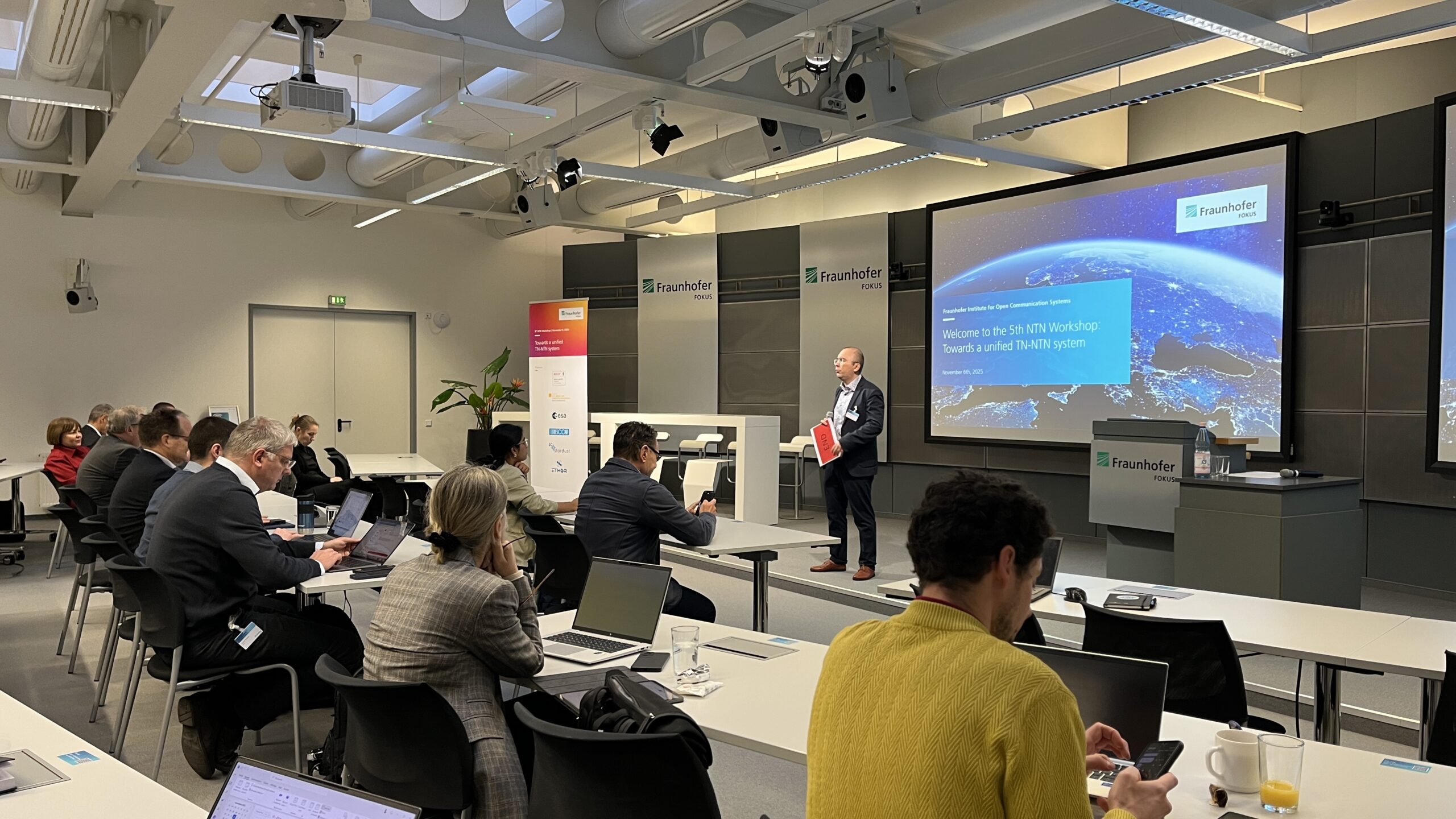
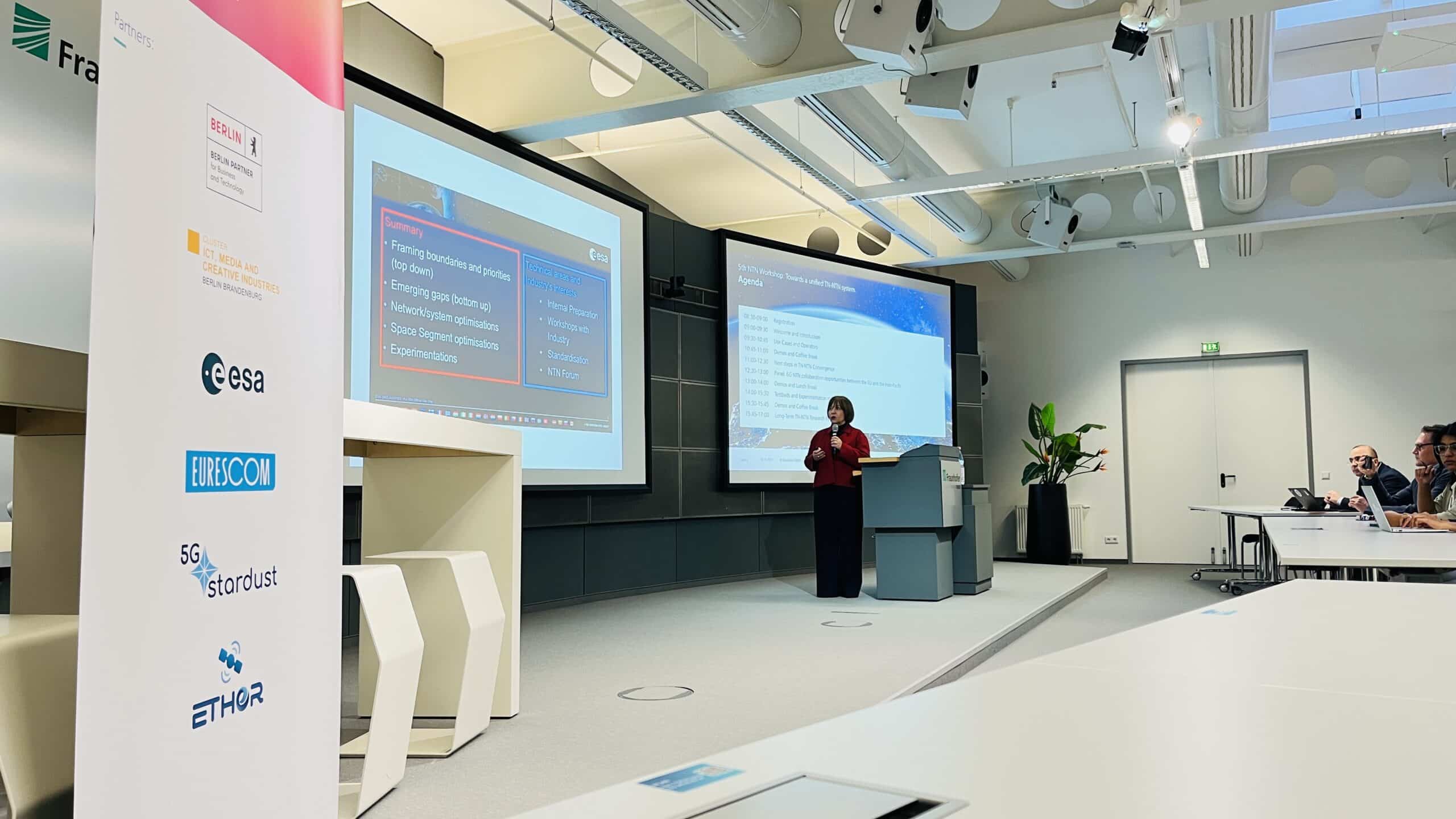
On November 6, the 5th NTN Workshop – Towards a Unified TN-NTN System, hosted by Fraunhofer FOKUS in Berlin brought together satellite operators, mobile network providers, research institutes, and industry innovators to discuss how Non-Terrestrial Networks (NTN) will seamlessly unify with terrestrial infrastructures in the emerging 6G era. Among the contributions, the ETHER project participated with a live demonstration and an expert presentation by project partner i2CAT, both showcasing how regenerative satellite payloads and semantics-aware connectivity can transform IoT service delivery in sparse constellation environments.
Extending IoT Connectivity Beyond the Terrestrial Footprint
A central challenge in future global connectivity is ensuring service continuity in regions where terrestrial infrastructure is impractical or non-existent — rural, maritime, aerospace, and polar environments. These are precisely the domains where satellite-based NTNs become indispensable. Yet, achieving smooth interoperability between terrestrial networks and LEO satellite constellations requires new architectures capable of managing intermittent coverage, service handovers, and efficient payload utilisation.
ETHER’s Use Case 1 addresses this challenge by exploring how flexible, regenerative payloads can support delay-tolerant NB-IoT communication over LEO satellites without the need for large, continuously-visible mega-constellations.
Live Demo – Store-and-Forward NB-IoT Service Provisioning Over Sparse Constellations
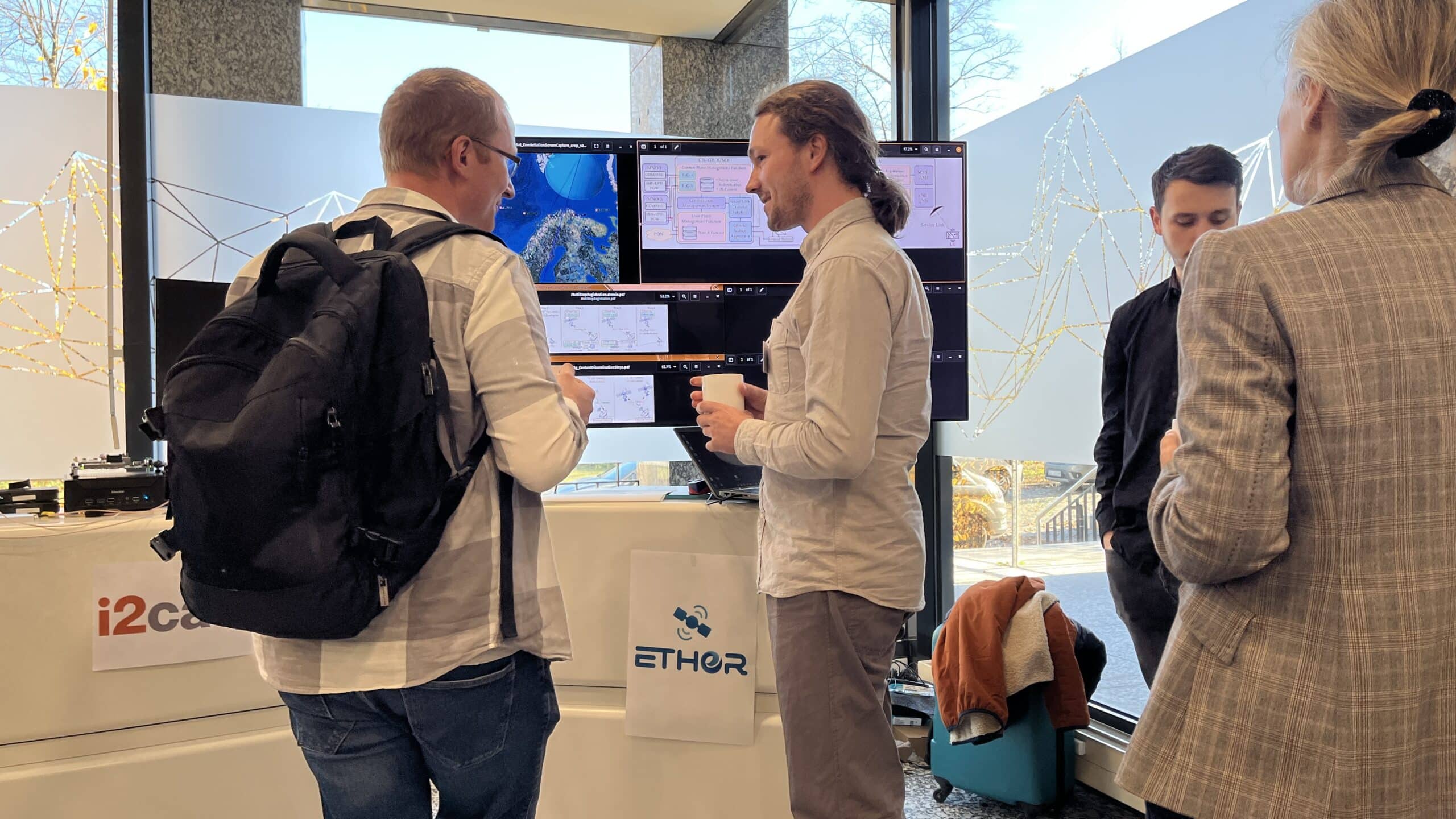
During the workshop, i2CAT presented the live demonstration:
Seamless Connectivity in Sparse Constellations Enabled by UE Context Dissemination for NB-IoT in Store-and-Forward Operation
The demo illustrated how IoT devices can maintain reliable NB-IoT connectivity even when satellite coverage is episodic — an essential requirement for many massive Machine Type Communication (mMTC) applications in remote environments.
Key technical outcomes highlighted in the demonstration:
- Flexible, software-defined satellite payloads allow NB-IoT service activation and management on-demand, adapting to coverage conditions dynamically.
- User Equipment (UE) context dissemination enables seamless handovers across satellites and between TN and NTN segments.
- Semantics-aware information handling (transmitting only the most significant information, based on the IoT application) reduces IoT device energy consumption by up to 75% — a significant benefit for long-lived battery-powered sensors (Delfani and Pappas, August 2025).
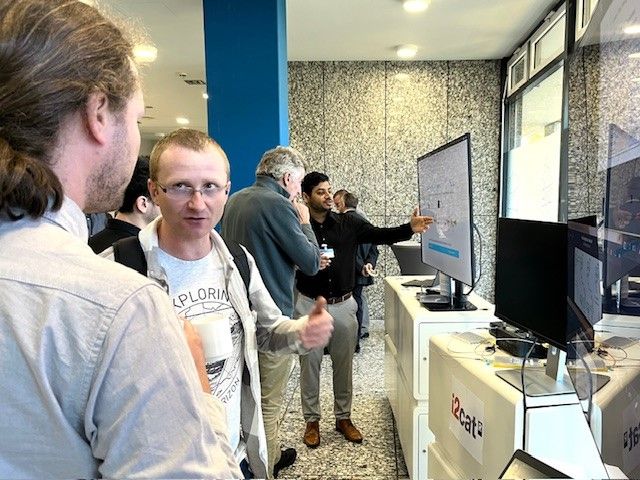
The ETHER partners that contributed to the development of this live demonstration activity are the following:
- i2CAT, as the leader of the demonstration activity, was responsible for the overall design, integration, and execution of the live demo. The team developed and implemented the flexible, software-defined regenerative payload, enabling store-and-forward operation with two-phase authentication and the dynamic orchestration of onboard functions through an NFV MANO framework. In addition, i2CAT designed and validated the UE context dissemination mechanism, allowing service and mobility information to be shared across satellites and with terrestrial networks to ensure seamless horizontal handovers and continuity of IoT services. The resulting setup, integrated by i2CAT in close collaboration with the project partners, brought together the flexible payload control, orchestration logic, and semantics-aware data exchange mechanisms demonstrated during the workshop.
- Linköping University (Communications for Networked Intelligent Systems Group) contributed on defining the relevant metrics that capture the semantic attributes of traffic and operational schemes that capture those (see related papers by Delfani et al. listed in the Publications box at the bottom), and assisted with the implementation.
- Ubiwhere, by integrating the IoT device in this demo, through the containerization of the Semantic-aware information handling service, enabling the energy-saving communication with the Satellite, and through the validation of this communication protocol, allowing for better visibility into these communications for accurate measurement of improvements.
- In addition, Martel Innovate organised the sponsorship and exhibition opportunity at the NTN workshop, and promoted the demonstration activities among the target stakeholder community.
These results showcase how intelligent satellite payloads can lower constellation complexity, improve service quality, and reduce device energy expenditure, supporting sustainable large-scale IoT deployments. Participants engaged actively during the demonstration, particularly with questions about how UE context is securely propagated across satellites and how service state is protected when instantiated or transferred across TN–NTN segments, reflecting strong interest in the practical deployment considerations behind these mechanisms.
The ETHER demo was presented alongside fellow SNS JU NTN project 5G-STARDUST, whose own demonstration on the exhibition floor contributed to a broader view of how complementary European research efforts are advancing the evolution of integrated TN-NTN systems.
Presentation – Rethinking Service Provisioning for Delay-Tolerant IoT
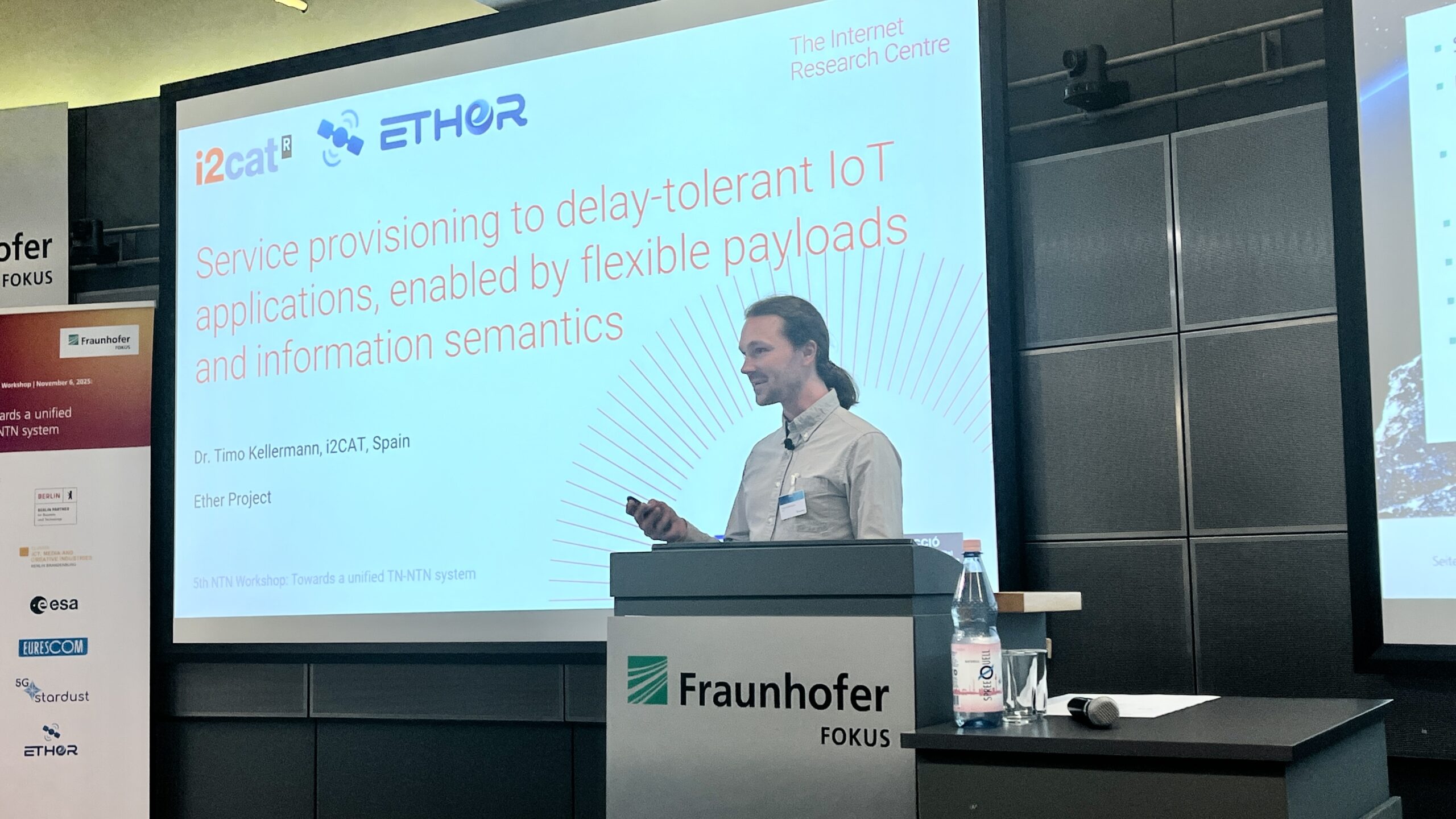
In the session “Testbeds and Experimentation in TN-NTN”, Dr. Timo Kellermann (i2CAT) expanded on the architectural foundations of this approach. His presentation:
“Service provisioning to delay-tolerant IoT applications, enabled by flexible payloads and information semantics”
outlined how software-defined payloads, context-aware orchestration, and semantics-based communication models can collaboratively enable dynamic, resilient, and energy-efficient service provisioning across hybrid TN-NTN infrastructures.
This aligns with a broader shift in communication system design: moving from transporting all data continuously to transporting the most significant data for the targeted IoT application, based on application meaning and urgency.
Scroll to the bottom of the article to discover the related scientific publications (Kellermann et al).
Real-World Applications: From Agriculture to Global Asset Tracking
The capabilities demonstrated in ETHER’s Use Case 1 carry direct relevance for large-scale, real-world IoT deployments, particularly in sectors where connectivity gaps have traditionally limited digitalisation efforts. Project partner Sateliot is driving this aspect by aligning NTN-enabled NB-IoT/5G NR ‘RedCap’ services with market needs across several high-impact verticals:
- Smart Agriculture: Soil sensors, irrigation control systems, and livestock trackers can operate in vast rural regions with no terrestrial coverage, enabling more efficient resource management and increased sustainability.
- Environmental Monitoring: Distributed sensor networks for biodiversity tracking, climate observation, and wildfire detection require long-lived, low-power devices able to transmit intermittently across remote landscapes.
- Global Supply Chain & Asset Tracking: Containers, heavy equipment, and maritime cargo can be tracked across oceans, borders, and sparsely populated regions, ensuring transparency and improved logistics planning.
- Infrastructure and Energy Networks: Pipeline monitoring, remote power sites, and offshore operations depend on reliable telemetry that does not rely on terrestrial footprints.
These application domains are delay-tolerant by design, meaning they are an ideal match for store-and-forward NB-IoT and semantics-aware data handling, which together reduce device energy use, extend sensor lifespan, and lower the operational cost of global-scale deployments.
Advancing the Path Toward Unified TN-NTN Architectures
The 5th NTN Workshop once again demonstrated the importance of shared experimentation environments, standardisation readiness, and cross-sector collaboration in shaping the future of NTN technology. ETHER’s contributions illustrate how intelligent in-orbit processing and semantics-driven IoT communication can help unlock practical and scalable NTN deployments.
A warm thank you to Fraunhofer FOKUS for hosting this year’s workshop and fostering an open and constructive exchange on the architectures and testbed strategies that will shape next-generation global connectivity.
Related scientific publications
Related publications
– UE Context Dissemination –
IEEE Open Journal of the Communications Society
UE Context Dissemination in Sparse LEO Constellations for 5G/6G Cellular IoT in Store and Forward Operation
by T. Kellermann, R. P. Centelles and A. Calveras – March 2025.
IEEE INFOCOM 2025 – IEEE Conference on Computer Communications Workshops
Demo: UE Context Dissemination in NTN for Global Store and Forward NB-IoT over LEO Satellites
by T. Kellermann, R. P. Centelles, S. Aguilar, S. Gupta, D. Camps-Mur and A. C. Augé – May 2025
– Semantics-Aware Information Handling –
IEEE Communications Letters
Semantics-Aware Updates From Remote Energy Harvesting Devices to Interconnected LEO Satellites
by E. Delfani and N. Pappas – August 2025
arXiv.org
Semantics-Aware Unified Terrestrial Non-Terrestrial 6G Networks
by E. Delfani, A. Mesodiakaki, N. Pappas – May 2025
22nd International Symposium on Modeling and Optimization in Mobile, Ad Hoc, and Wireless Networks (WiOpt)
Semantics-Aware Status Updates with Energy Harvesting Devices: Query Version Age of Information
by E. Delfani and N. Pappas – October 2024